
What Prop 65 Receipt-Paper Notices Mean for California Restaurants
Quick Take
- Prop 65 notices linked to bisphenol S (BPS) in thermal receipt paper are still appearing across California.
- Recent 60-day notices filed with the California Attorney General indicate private enforcement remains active.
- Notices often request documentation on receipt paper, including SKU/spec sheets, supplier details, and purchasing records.
- Public records show that some businesses are choosing to settle with specific compliance dates and procurement requirements.
Why restaurants are seeing Prop 65 receipt-paper notices
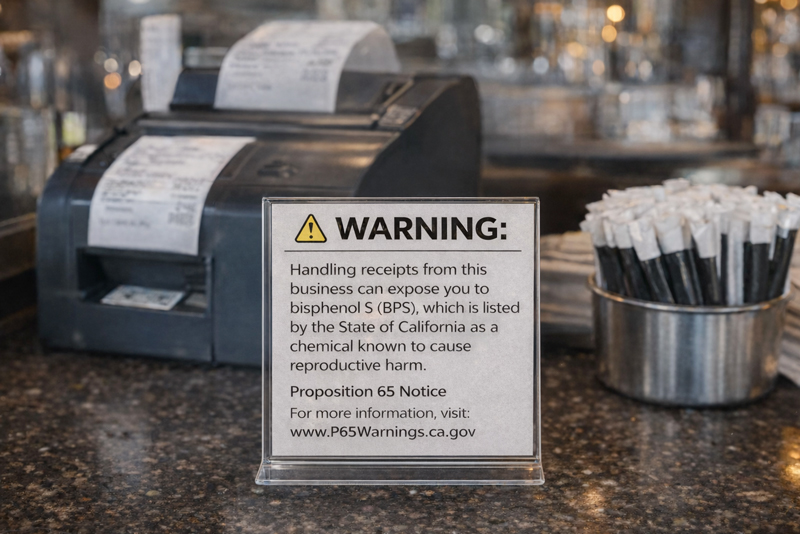
Across California, restaurants and retailers are receiving Prop 65 notices tied to bisphenol S (BPS) in thermal receipt paper. Prop 65 is enforced through a combination of public agencies and private parties, and the receipt-paper issue has become a recurring theme as businesses look to reduce exposure risk and avoid costly disputes.
Recent 60-day notices filed with the California Attorney General suggest private enforcement remains active, and some matters appear to be resolving through settlement rather than litigation.
What is driving this?
BPS is used as a color developer in some thermal papers. OEHHA added BPS to the Prop 65 list in late 2023 and issued additional listing updates in 2025. Since then, private parties have sent notices alleging exposure through routine handling of receipts. OEHHA has also issued guidance specific to BPS in receipt paper and certain thermal labels.
For operators, the practical issue is not just the notice itself. It is the operational follow-through that can come with it: identifying exactly what paper is being used, who supplied it, and what alternatives or compliance steps are available.
What enforcement looks like right now
Based on what restaurant operators report seeing, Prop 65 receipt-paper notices can include several recurring elements.
- A 60-day notice period before a complaint can be filed.
- Requests for documentation tied to the specific receipt paper in use, such as SKU or spec sheets, supplier information, and purchasing records.
- Questions about responsibility that can arise between operators, POS vendors, and suppliers.
- Public records show that some businesses have chosen to settle rather than litigate, including settlements with specific compliance dates and paper procurement restrictions.
This is one reason documentation matters. When a notice arrives, operators often need to quickly confirm which product they are using and which options are available in their supplier’s or POS ecosystem.
Why this matters for restaurant operators
Prop 65 is a warning statute with real penalties. When notices target routine touchpoints like receipts, the issue can touch multiple parts of restaurant operations: purchasing, documentation, point-of-sale workflows, and communications with customers and staff.
Even when a restaurant believes it is doing the right thing, a notice can create immediate time pressure and a need for clear facts. That is why it helps to know where to find public information and what the most common requests look like.
Where to find public information
If you want to see public information and the broader enforcement context, start with these two sources:
- Office of Environmental Health Hazard Assessment (OEHHA): general Prop 65 resources and listed chemicals.
- California Attorney General’s Prop 65 portal: background on enforcement and 60-day notices.
If you receive a notice, use these sources to understand the broader context and to confirm what has been publicly filed. Then coordinate with your supplier and advisors to determine what documentation you can produce and what options make sense for your operation.
Stay ahead of issues that can impact your operations.
CRMBC offers practical guidance for California restaurants on safety, claims, and compliance issues that can affect your bottom line.
CRMBC member?
Explore resources and tools designed for you and your teams.
Not yet a member?
Find out if your restaurant qualifies to join CRMBC and get a workers’ compensation program built for California restaurants, plus practical support you can use across locations.Contact CRMBC to take the first step.

Kaya Stanley is an attorney, published author, business owner, and highly sought-after strategic turnaround expert. Ms. Stanley serves as CEO and Chairman of the Board for CRMBC, the largest restaurant workers’ compensation self-insured group in California, and she is the Licensee for TEDxReno, an independently organized TEDx Event.
Throughout her 22 years of practicing law, Ms. Stanley has served as outside counsel for Wal-Mart and Home Depot. She was voted one of the country’s “Top 25 OZ Attorneys” by Opportunity Zone Magazine and published a best-selling book called “The Employer’s Guide to Obamacare.” Before that, she earned her master’s degree in social work and public policy, after which she worked with at-risk girls in Detroit and lobbied for women and families.