


Quick Take
- Review cumulative trauma claim activity across your locations, especially by employee tenure, injury type, and legal representation.
- Flag long reporting delays and overlapping cumulative trauma and specific injury allegations for early claims review.
- Preserve job-duty, scheduling, training, incident, video, witness, and employee communication records.
- Bring the claims team in early when repetitive strain, mental health, or multiple body systems appear in a claim.
- Monitor CWCI research and possible changes in legislation, regulation, judicial decisions, and litigation strategy.
I recently had the opportunity to attend the annual California Coalition on Workers’ Compensation (CCWC) conference.
Three themes dominated many of the discussions:
- Cumulative trauma (CT) claims are increasing at an alarming rate.
- Medical inflation continues to drive claim costs higher.
- A concept known as allostatic load may further accelerate both trends.
I’ll save medical inflation and allostatic load for future posts. Today, I want to focus on cumulative trauma.
The California Workers’ Compensation Institute (CWCI) presented research that validates what many of us on the claims side have been experiencing for years.
The numbers are difficult to ignore.
- The average cumulative trauma claim is reported 275 days after the alleged date of injury.
- 39.7% of reported CT claims involve no medical treatment.
Regionally, CT filings continue to accelerate.
- Valley regions: +81%
- Inland Empire & Orange County: +69%
- North Counties/Sierras: +45%
- Central Coast: +43%
CT Rates Are Increasing Across California’s Economy
One of the more compelling findings from CWCI is that cumulative trauma is no longer confined to a handful of traditionally high-risk occupations. CT rates are increasing across virtually every major industry.
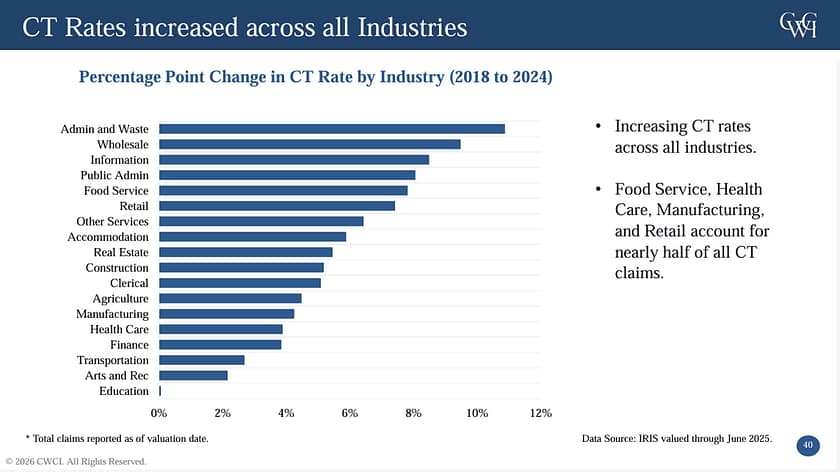
Several observations stand out:
- Administrative & Waste Services experienced the largest increase in CT rates.
- Wholesale, Information, Public Administration, Food Service, and Retail all posted substantial increases.
- Even Finance, Transportation, Arts & Recreation, and Education experienced measurable growth.
- Food Service, Health Care, Manufacturing, and Retail now account for nearly one-half of all cumulative trauma claims statewide.
The takeaway is clear: cumulative trauma has become a statewide issue affecting virtually every sector of California’s workforce rather than remaining concentrated in traditionally labor-intensive occupations.
Where CT Claims Are Most Concentrated
The second chart presented by CWCI adds another important dimension. While CT rates are increasing across nearly every industry, some sectors continue to account for a disproportionate share of these claims.
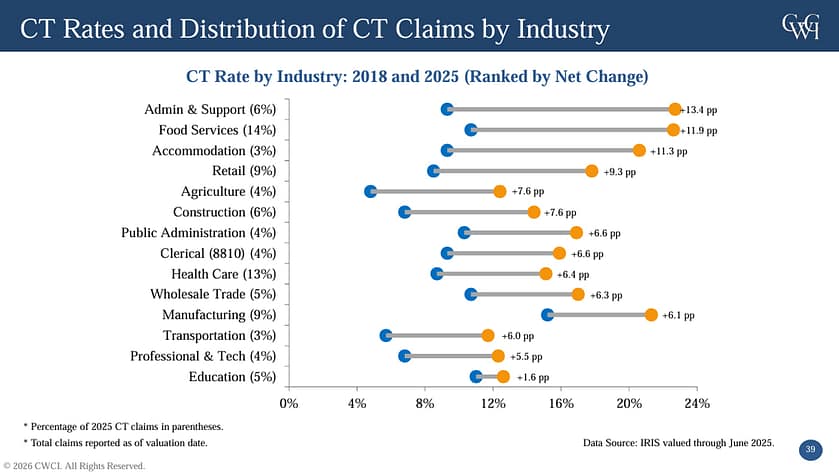
Administrative & Support Services experienced the largest increase in CT rates between 2018 and 2025 (+13.4 percentage points), followed by Food Services (+11.9), Accommodation (+11.3), and Retail (+9.3). Manufacturing, Health Care, Construction, Public Administration, and Wholesale Trade all experienced significant increases as well.
Together, these two charts tell an important story. The first shows that CT rates are rising throughout California’s economy. The second identifies where those increases are becoming most concentrated. The trend is both broad-based and deepening.
Mental Disorders and Soft Tissue Injuries Are Also Fueling This Growth
Between 2018 and 2024:
- Mental disorder CT claims: +146%
- Low back CT claims: +66%
- Multiple body system claims: +64%
Another interesting finding comes from earlier CWCI research. As of 2022, approximately 25% of CT claims overlapped with either a specific injury, multiple cumulative trauma claims (such as hypertension or internal conditions), or a combination of both. Given the trajectory of the current data, it seems reasonable to expect that percentage has continued to increase.
Employee tenure is another noteworthy factor. Approximately 50% of cumulative trauma claims are filed by employees with five years of service or less.
The litigation statistics are equally striking.
- Approximately 90% of CT claims are litigated.
- Approximately 95% of CT filings statewide are submitted by attorney firms located in Southern California.
- Between 2018 and 2024, Northern California experienced a 380% increase in representation by attorney firms located in Orange County and the Inland Empire.
Why Does This Matter?
CWCI is dedicating significant research resources to cumulative trauma. Historically, when the Institute devotes this level of attention to an issue, policymakers often aren’t far behind.
Having worked through several major workers’ compensation reforms beginning in 1992, I’ve learned that watershed reforms rarely unfold exactly as intended. They often solve one problem while creating new challenges elsewhere in the system.
Whether the response to the current CT trend ultimately comes through legislation, regulation, judicial decisions, or changes in litigation strategy remains to be seen.
What seems increasingly clear is that cumulative trauma is no longer an isolated claims issue. It has become one of the defining trends in California workers’ compensation, and one every employer, claims professional, attorney, and risk manager should be watching closely.
In my next post, I’ll discuss another major topic from CCWC—medical inflation—and why the concept of allostatic load may become increasingly important in understanding future workers’ compensation claims.
Resources You Can Use Today
Review CRMBC University: Claims Essentials for practical guidance on reporting, documentation, and working with your claims team.
Not yet a member?
Talk with CRMBC about whether a self-insured group is a fit for your restaurant.

Randy Bugg is Senior Vice President at Pacific Claims Management (PCM), a third-party administrator specializing in workers’ compensation claims management. With more than 34 years of experience in the workers’ compensation industry, Mr. Bugg brings extensive expertise in claims administration, investigation, cost containment, and strategies designed to achieve timely and effective claim resolution.
Throughout his career, Mr. Bugg has worked closely with employers and self-insured organizations to improve claims outcomes and manage the financial impact of workplace injuries. At Pacific Claims Management, he emphasizes proactive claims handling, early reporting, thorough documentation, and individualized service. He also works closely with CRMBC and its members, providing guidance on claims management, return-to-work strategies, settlement practices, and the advantages of effective self-insurance programs.

